名
Character Story & Explanation
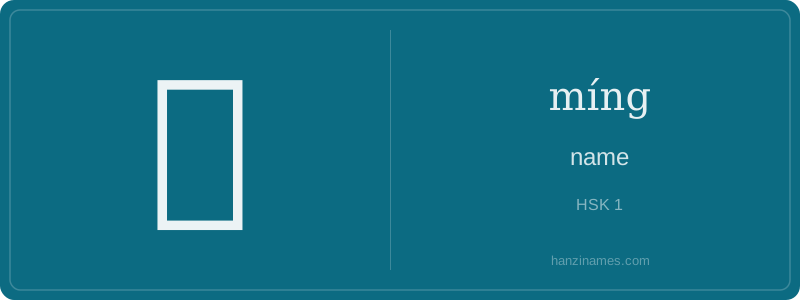
名 is indispensable in daily Chinese life: it appears on ID cards (身份证), school rosters, and WeChat profiles—and is central to the HSK 1 question 你叫什么名字? (What’s your name?). Historically, the Rites of Zhou (3rd c. BCE) mandated formal naming ceremonies on the 100th day after birth, underscoring 名’s role in social recognition. Common idioms include 有名无实 (yǒu míng wú shí, 'famous in name only') and 不可名状 (bù kě míng zhuàng, 'indescribable').
The character’s earliest confirmed form (c. 1200 BCE oracle bones) shows 口 (mouth) above 夕 (evening), reflecting the practice of announcing names aloud at dusk gatherings. It is not a pictograph of a person or object—but a logical compound: voice + time of communal assembly = identifier.
Our detective begins at the Shāng dynasty oracle bones—where 名 appears as a composite glyph: a 'mouth' (口) beneath a simplified 'evening' or 'twilight' sign (originally 口 + 月, later stylized). Scholars like Li Xiaoding note this likely represented calling out a name at dusk—a time for ritual announcements or roll calls. The mouth radical signaled vocalization: names were spoken, not just written. This early form already carried the core idea of identity through utterance.
By the Warring States period, 名 stabilized into its modern shape: 口 atop 夕 (a variant of 月), with strokes simplifying into today’s six-line structure. The ‘evening’ component evolved phonetically—its Old Chinese pronunciation *mreŋ overlapped with 名’s sound—while retaining semantic weight: names mark presence, especially when called aloud in gathering spaces like ancestral halls or military musters. No divine etymology; it’s pragmatic linguistics and social function.
Fast-forward to the Qin standardization: 名 was codified in the Small Seal Script with clean, balanced strokes—still unmistakably mouth + twilight. Its HSK Level 1 status reflects how foundational it is: without 名, you can’t ask ‘What’s your name?’ (你叫什么名字?), fill forms, or read passports. It’s not abstract—it’s administrative, relational, and deeply embedded in Confucian naming rites, where one’s given name (名) distinguished personal identity from family title (姓) and courtesy name (字).
Example Sentences
Common Compounds
Similar Characters — Don't Mix These Up
Your First Step into Chinese Culture: Get a Chinese Name
Every journey into Chinese begins with a name. Use our free Chinese name generator to create a meaningful, personalized Chinese name that fits you perfectly.
Get My Chinese Name →