江
Character Story & Explanation
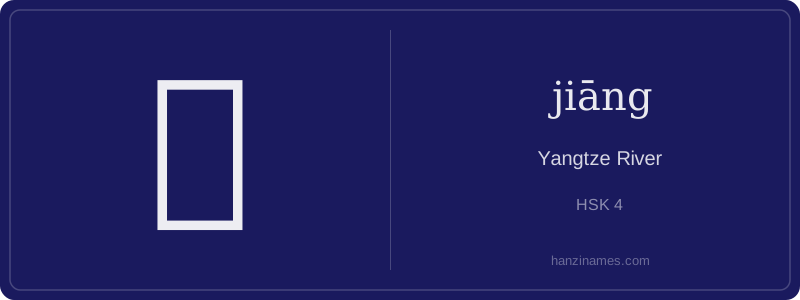
In modern Chinese, 江 appears ubiquitously: in geographical names (Jiangsu, Jiangxi), news headlines about flood control on the Yangtze, and idioms like ‘江山易改,本性难移’ (jiāngshān yì gǎi, běnxìng nán yí)—‘rivers and mountains may change, but innate nature is hard to alter.’ Historically, it was central to imperial transport, tax collection, and literary symbolism—Du Fu’s poems reference the ‘Yangtze’s waves’ as metaphors for time and exile.
The character’s origin is well-documented: it evolved from oracle-bone script forms depicting flowing water beside a phonetic indicator (early 工). No disputed myths—just practical orthography. Today, Chinese students write it daily in geography class or when addressing letters to ‘Nanjing, Jiangsu Province,’ grounding the character in real administrative and spatial cognition.
As a linguistic detective, I begin with the character’s radical: 氵—three water dots, the standard 'water' classifier. This tells us immediately that 江 belongs to the hydrological semantic family—rivers, lakes, floods. Its right-hand component, 工 (gōng), is not merely decorative; in early seal script, it served as a phonetic loan, approximating the ancient pronunciation *kroŋ or *klaŋ, later evolving into jiāng. The combination isn’t pictorial but phono-semantic: water + sound clue.
The six-stroke structure hides centuries of refinement. In bronze inscriptions (c. 11th–3rd century BCE), 江 appeared with variants like 巟 (a variant with ‘empty’ 工 + ‘earth’ 土), reflecting its association with vast, flowing emptiness. By the Qin dynasty’s small seal script, the form stabilized into today’s 氵+工—streamlined for bureaucratic efficiency yet retaining its acoustic and conceptual core: a major river defined by scale and directionality.
Crucially, 江 never meant ‘river’ generically in classical usage—it specifically denoted the Yangtze, China’s longest river and civilizational artery. Other rivers bore distinct names (e.g., 黄河 Huáng Hé for the Yellow River). Only gradually, via semantic extension in Middle Chinese, did 江 broaden to mean ‘large river’—a shift documented in Tang poetry and Song administrative texts. This specificity-first evolution underscores how geography shaped language: one river, one character, immense cultural weight.
Example Sentences
Common Compounds
Similar Characters — Don't Mix These Up
Your First Step into Chinese Culture: Get a Chinese Name
Every journey into Chinese begins with a name. Use our free Chinese name generator to create a meaningful, personalized Chinese name that fits you perfectly.
Get My Chinese Name →