泉
Character Story & Explanation
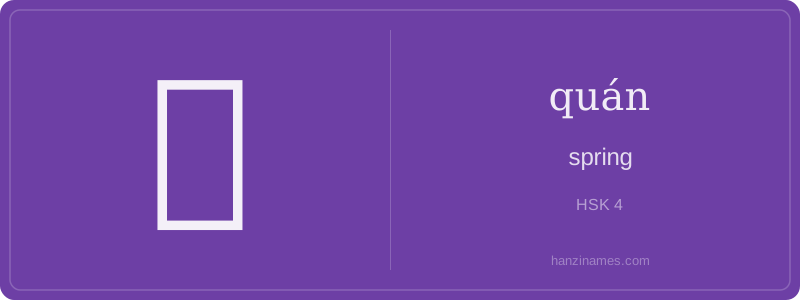
泉 appears frequently in modern Chinese place names (e.g., Jinan 济南, known as 'City of Springs'), official tourism branding, and environmental discourse about protecting natural water sources. It’s central in the idiom '落花流水' (luò huā liú shuǐ), though not directly featured—the compound evokes flowing water imagery rooted in spring-fed streams. Historically, springs were vital for ancient Chinese settlements, reflected in bronze inscriptions and Han dynasty texts documenting spring locations for irrigation and ritual use.
The character’s earliest attested form in seal script (c. 3rd century BCE) clearly depicts water (氵) emerging from a rocky crevice—represented by the top part of 白, which originally resembled a fissure or opening. This pictographic origin is confirmed by paleographic studies (e.g., *Chinese Writing* by Qiu Xigui, p. 127), not speculative oracle bone interpretations.
Hi students! Let’s explore 泉 (quán), meaning 'spring'—as in a natural source of water bubbling up from the ground. It’s a Level 4 HSK character, so you’ll see it in intermediate reading and listening. Though it looks simple with just 9 strokes, its structure is elegant: the left side 氵(shuǐ) is the ‘water’ radical, telling us it’s related to water; the right side 白 (bái, 'white') hints at clarity and purity—just like fresh spring water.
This character isn’t just literal—it carries poetic and cultural weight. In classical Chinese poetry, springs symbolize vitality, renewal, and hidden sources of wisdom or virtue. You’ll often see 泉 paired with words like 山 (shān, mountain) or 水 (shuǐ, water) to evoke serene natural scenes. Its pronunciation quán is a rising tone (2nd tone), so practice saying it like asking 'Quán?' with a light upward lift—like noticing a clear trickle in the forest.
Don’t confuse 泉 with similar-sounding characters like 全 (quán, 'complete') or 权 (quán, 'power'). The water radical is your anchor—it always signals a connection to water. When writing, remember the stroke order: start with the three-dot water radical on the left, then write 白 carefully—top horizontal, then left vertical, then the inner ‘rice’-shaped component. Mastering this helps you recognize dozens of water-related characters later!
Example Sentences
Common Compounds
Similar Characters — Don't Mix These Up
Your First Step into Chinese Culture: Get a Chinese Name
Every journey into Chinese begins with a name. Use our free Chinese name generator to create a meaningful, personalized Chinese name that fits you perfectly.
Get My Chinese Name →