洋
Character Story & Explanation
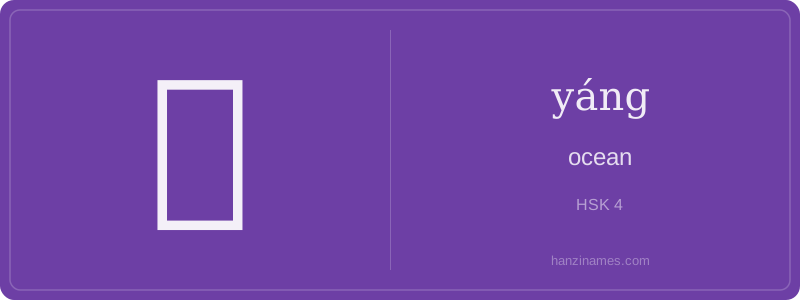
In daily life, 洋 most commonly appears in compound words denoting foreignness or oceanic scale: 洋货 (yánghuò, 'foreign goods'), 洋气 (yángqì, 'sophisticated/modern style'), and 洋葱 (yángcōng, 'onion' — historically 'foreign onion'). Historically, during the late Qing and Republican eras, 洋 became shorthand for Western influence — e.g., 洋务运动 (Yángwù Yùndòng, 'Self-Strengthening Movement') reflected state-led adoption of Western technology. The term 洋行 (yángháng, 'foreign trading firm') dates to 19th-century treaty ports like Shanghai.
The character’s form has no oracle-bone or bronze-age pictograph. It first appears reliably in seal script (c. 3rd century BCE) as a phono-semantic compound — not a picture of ocean, but a deliberate construction: water radical + 羊 for sound. Its enduring function is lexical precision: signaling both aquatic vastness and cultural externality.
As a linguistic detective, I begin with the modern form: 洋 is a left–right character — the water radical 氵 on the left, and a phonetic component 羊 (yáng) on the right. This structure reveals its nature as a phono-semantic compound: the radical hints at meaning (water-related), while 羊 provides pronunciation clues. Though 羊 means 'sheep', its ancient pronunciation overlapped closely with yáng, making it an effective phonetic anchor.
Zooming back to the Warring States and Han dynasty scripts, 洋 appears in early bamboo slips and bronze inscriptions with minor stylistic variations but consistent structure. Unlike pictographic characters like 日 (sun), 洋 wasn’t drawn from direct observation of waves — it was engineered: water + sound. Its semantic scope expanded early from ‘ocean’ to include ‘foreign’ (e.g., 洋货 — foreign goods), reflecting how oceans mediated China’s contact with the outside world.
The radical 氵 (three-dot water) itself evolved from the full character 水 (shuǐ). Scribes simplified it for efficiency when used as a left-side component — a pragmatic adaptation seen across hundreds of water-related characters. Meanwhile, 羊 retained its shape but lost its original sheep-meaning in this context; here, it’s purely phonetic. This duality — semantic clarity + phonetic utility — exemplifies the ingenious logic underlying Chinese script’s longevity.
Example Sentences
Common Compounds
Similar Characters — Don't Mix These Up
Your First Step into Chinese Culture: Get a Chinese Name
Every journey into Chinese begins with a name. Use our free Chinese name generator to create a meaningful, personalized Chinese name that fits you perfectly.
Get My Chinese Name →