洲
Character Story & Explanation
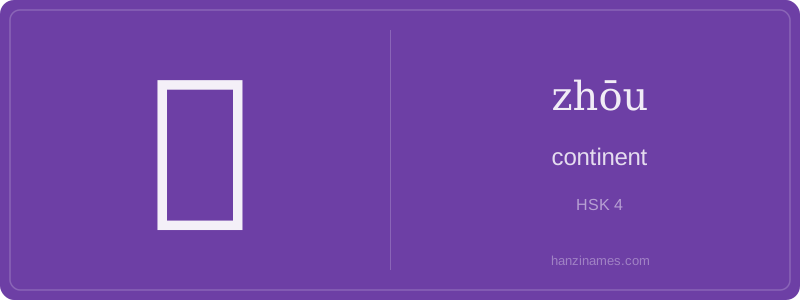
In modern Chinese, 洲 most commonly appears in proper nouns for continents—亚洲 (Yàzhōu, Asia), 欧洲 (Ōuzhōu, Europe), 非洲 (Fēizhōu, Africa), etc.—and is standard in geography education, news media, and international diplomacy. It also appears in place names like Hainan Island’s historic name 瓊洲 (Qióngzhōu), and in the idiom 五洲四海 (wǔ zhōu sì hǎi), meaning 'the five continents and four seas', signifying global reach or universal unity—a phrase used since at least the Ming dynasty in imperial edicts and modern PRC state rhetoric.
The character’s form is well-documented: 洲 first appears in seal script (c. 3rd century BCE) as a semantic-phonetic compound—氵 (water) + 州 (zhōu, phonetic and originally meaning ‘alluvial island’). In oracle bone and bronze inscriptions, 州 depicted three curved lines representing river branches enclosing a dot or stroke—symbolizing an island formed by water. This origin remains visible in the modern character’s structure.
The character 洲 (zhōu) embodies a profound geographical and philosophical layer of the Chinese worldview: land emerging from water—not as isolated territory, but as life-sustaining islands in a vast, dynamic aqueous world. Historically, early Chinese civilization flourished along rivers and coastlines, so ‘continent’ was not conceived as a massive, abstract landmass like in Eurocentric cartography, but as habitable, fertile alluvial plains or riverine islets—places where water and earth harmoniously converge to nurture human settlement.
This reflects the classical yin-yang sensibility: 洲 is never imagined apart from 氵 (water radical), signaling that land’s existence and value are defined by its relationship to water—not dominance over it. Even today, ‘Asia’ (亚洲 Yàzhōu) and ‘Europe’ (欧洲 Ōuzhōu) are named with 洲, subtly reinforcing that continents are not just physical spaces but culturally recognized realms shaped by hydrological and civilizational boundaries.
Unlike Western maps that often center political borders, traditional Chinese cosmographic thought locates 洲 within relational networks—between rivers, seas, and heavens. The term appears in classical texts like the Shanhai Jing (Classic of Mountains and Seas), where mythical ‘islands’ or ‘lands’ (e.g., Penglai 澎洲) symbolize idealized, balanced worlds. Thus, 洲 carries quiet ethical weight: true continental identity arises not from size or power, but from ecological harmony and cultural continuity.
Example Sentences
Common Compounds
Similar Characters — Don't Mix These Up
Your First Step into Chinese Culture: Get a Chinese Name
Every journey into Chinese begins with a name. Use our free Chinese name generator to create a meaningful, personalized Chinese name that fits you perfectly.
Get My Chinese Name →