活
Character Story & Explanation
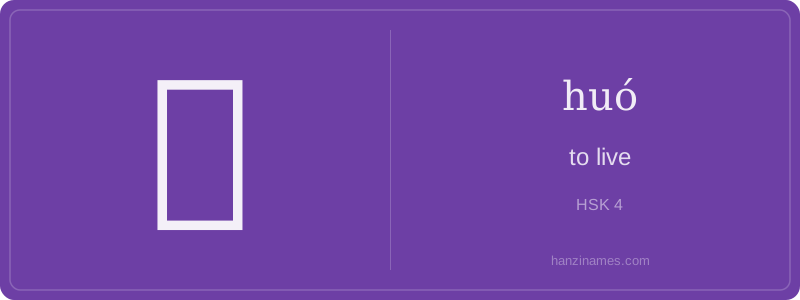
In daily life, 活 is indispensable: it appears in HSK 4 vocabulary like 生活 (shēnghuó, 'life'), 活动 (huó dòng, 'activity'), and 活着 (huózhe, 'to be alive'). It’s central to the Confucian phrase '学而时习之,不亦说乎?有朋自远方来,不亦乐乎?人不知而不愠,不亦君子乎?'—where 'living' (as active practice) underpins learning. The idiom 起死回生 (qǐ sǐ huí shēng, 'revive the dead') uses 活 implicitly via 回生 ('return to life'). Historically, Tang dynasty medical texts used 活 to describe 'vital qi circulation'.
The character’s form derives from seal script 活 (⿰氵會), where 氵 signals fluidity/life-force and 會 (*huì*) contributed sound and the sense of 'convergence'—as in vital energies gathering to sustain life. No pictographic origin exists; it’s a deliberate, literate construction reflecting Warring States-era philosophical linguistics.
Our detective begins at the crime scene: the character 活, first attested in seal script (c. 3rd century BCE), already bearing its modern structure—three water dots (氵) on the left and 14-stroke 叚 on the right. Wait—correction: the right component is actually (a variant of 會 *huì*, meaning 'to gather, meet'), not 叚. Early forms show 氵+會, suggesting 'flowing together' or 'dynamic convergence'—a conceptual leap toward vitality, not just literal water. This semantic shift reflects how ancient Chinese thinkers linked life with movement, change, and fluidity.
The radical 氵 (water) isn’t arbitrary—it anchors 活 to the classical cosmological idea that water symbolizes adaptability, renewal, and ceaseless motion—qualities essential to being alive. Unlike static characters like 死 (death), 活 pulses with kinetic energy. By Han dynasty bamboo slips, 活 consistently meant 'to live', 'to be alive', or 'to operate', confirming its semantic stabilization over 2,000 years. No oracle bone inscriptions contain 活; it emerged later as written language matured.
Modern linguistic analysis confirms 活 is a phono-semantic compound: 氵 conveys the life-fluid association, while (historically pronounced *huò* or *huái*) provided phonetic approximation to *huó*. Tone shift from *huò* to *huó* aligns with Middle Chinese tonal evolution. Crucially, 活 never meant 'water'—its water radical is metaphorical, not literal. This distinguishes it from characters like 河 (river) or 泪 (tears), where 氵 denotes physical water. Here, it’s philosophy in ink.
Example Sentences
Common Compounds
Similar Characters — Don't Mix These Up
Your First Step into Chinese Culture: Get a Chinese Name
Every journey into Chinese begins with a name. Use our free Chinese name generator to create a meaningful, personalized Chinese name that fits you perfectly.
Get My Chinese Name →