流
Character Story & Explanation
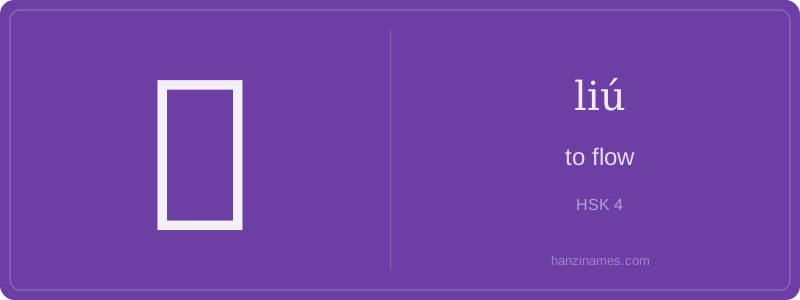
In daily life, 流 is indispensable: it appears in HSK 4 vocabulary like 流感 (liúgǎn, ‘influenza’, literally ‘flowing illness’—named for its rapid spread), 流泪 (liú lèi, ‘to shed tears’), and 流程 (liúchéng, ‘procedure/flowchart’). The idiom 细水长流 (xì shuǐ cháng liú, ‘a thin stream flows long’) is widely used in financial advice and relationships, emphasizing sustainability over intensity—documented in Ming-dynasty texts and still featured in CCTV public service announcements.
Historically, 流 evolved from the bronze script form of 氵+㐬, where 㐬 was a phonetic component. While its earliest forms (c. 1000 BCE) depict water flowing around a bend, scholars confirm the modern shape stabilized by the Han dynasty. Today, Chinese students practice its 10-stroke order daily—and you’ll see it handwritten on shop signs like ‘客流旺’ (kè liú wàng, ‘customer flow booming!’) in Shanghai’s Nanjing Road.
Imagine standing on the stone steps of Hangzhou’s West Lake at dawn—the water ripples gently as a breeze stirs lotus leaves. A vendor pushes his bamboo cart along the lakeside path, calling out 'liú shuǐ bīng!' (flowing-water ice!) for his chilled osmanthus jelly dessert. Here, 流 isn’t just abstract grammar—it’s the liquid shimmer of light on water, the movement of people and goods, the quiet pulse of daily life in motion.
Chinese learners often first meet 流 in verbs like 流动 (liúdòng, to flow/move) or 流行 (liúxíng, to be popular), both rooted in this core idea of continuous, unobstructed movement. Its radical 氵 (three-dot water) anchors it visually and semantically to liquidity—whether literal (a river), metaphorical (trends), or physiological (tears, sweat, blood).
The character appears constantly in modern signage: subway line maps (‘Line 10’ is 十号线, shí hào xiàn), hospital notices (‘outpatient flow’ = 就诊流程, jiùzhěn liúchéng), even food delivery apps showing ‘order flow’. It’s not a literary relic—it’s infrastructure language, silently shaping how Chinese speakers conceptualize time, change, and connection.
Example Sentences
Common Compounds
Similar Characters — Don't Mix These Up
Your First Step into Chinese Culture: Get a Chinese Name
Every journey into Chinese begins with a name. Use our free Chinese name generator to create a meaningful, personalized Chinese name that fits you perfectly.
Get My Chinese Name →