减
Character Story & Explanation
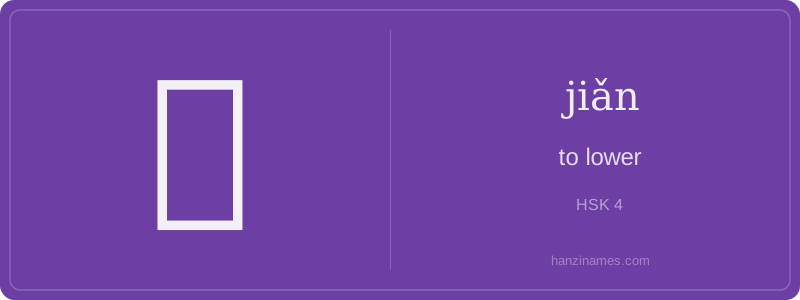
减 is ubiquitous in contemporary Chinese policy and daily speech: the national ‘double reduction’ policy (双减 shuāng jiǎn) launched in 2021 reduced after-school tutoring and homework loads for students—a landmark educational reform widely reported by Xinhua and the Ministry of Education. Common phrases include 减肥 (jiǎn féi, ‘lose weight’) and 减税 (jiǎn shuì, ‘cut taxes’), both appearing in official documents and health campaigns since the 1980s.
The character evolved from seal script (c. 3rd century BCE), where it combined 冫 (ice, suggesting coldness/calm reduction) and 尝 (a phonetic component, later simplified to 咸). Though not pictographic, its modern form—冫+咸—reflects standardized clerical script reforms under the Qin dynasty, emphasizing phonetic-semantic structure over visual metaphor.
The character 减 (jiǎn) embodies a quiet but profound principle in Chinese thought: the value of reduction—not as loss, but as refinement. In Daoist and Confucian traditions, less can mean more—less clutter, less excess, less ego—leading to clarity, balance, and virtue. This reflects a worldview where growth isn’t always additive; sometimes, true progress comes from subtraction: simplifying life, moderating desire, or releasing what no longer serves harmony.
Historically, 减 appears in classical texts like the *Huainanzi* and imperial fiscal records, where it denoted measured reduction—of taxes, labor conscription, or punishments—to maintain social equilibrium. Its presence in governance signals wisdom in restraint: lowering burdens to sustain stability, echoing the ancient ideal of ‘ruling by non-interference’ (wu wei). Reduction here is strategic, humane, and deeply relational.
In modern China, 减 remains culturally resonant beyond arithmetic—it’s embedded in wellness (减压 jiǎn yā, ‘reduce stress’), sustainability (减排 jiǎn pái, ‘cut emissions’), and education reform (减负 jiǎn fù, ‘lighten student workload’). These usages reveal an enduring cultural preference for calibrated adjustment over radical change—lowering pressure, not expectations; trimming excess, not essentials. Thus, 减 is not diminishment, but intentional recalibration toward balance.
Example Sentences
Common Compounds
Similar Characters — Don't Mix These Up
Your First Step into Chinese Culture: Get a Chinese Name
Every journey into Chinese begins with a name. Use our free Chinese name generator to create a meaningful, personalized Chinese name that fits you perfectly.
Get My Chinese Name →