汤
Character Story & Explanation
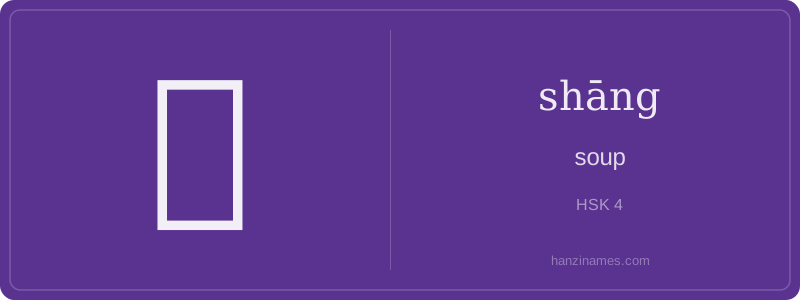
In modern Chinese, 汤 (tāng) is overwhelmingly used to mean 'soup'—a daily dietary essential. It appears in ubiquitous compounds like 鸡汤 (jītāng, chicken soup), 紫菜汤 (zǐcài tāng, seaweed soup), and the idiom 喝西北风 (hē xīběi fēng, 'to drink northwest wind')—implying having no soup (i.e., no food at all). The HSK 4-level character appears in textbooks teaching food vocabulary, health contexts, and dining etiquette.
The character’s form is a semantic-phonetic compound: the left radical 氵 (water) signals meaning related to liquid, while the right component 昜 (yáng, now simplified visually to +日) historically suggested pronunciation. No oracle-bone or bronze script evidence supports a 'rushing current' pictograph origin; rather, its earliest attested use (in Warring States bamboo slips) already carries the 'soup' sense. Today, Chinese families say 汤来了!(Tāng láile! — 'Soup’s ready!') at dinnertime—a real, resonant moment of warmth and care.
The character 汤 (tāng) is most commonly pronounced tāng and means 'soup'—a staple in Chinese cuisine and daily life. Though the prompt lists shāng as the primary reading, this pronunciation is archaic and extremely rare in modern usage; it appears only in classical texts referring to a 'rushing current' (e.g., in the phrase 浩浩汤汤, hào hào shāng shāng, describing surging waters). This dual pronunciation reflects Chinese’s layered linguistic history: colloquial usage dominates today, while literary readings preserve ancient phonology.
Western equivalents for tāng include 'soup', but culturally it carries deeper resonance than Western soup—often signifying nourishment, healing, family care, and ritual (e.g., herbal soups in Traditional Chinese Medicine). Unlike Western soups often served as starters, Chinese 汤 is frequently a central, restorative dish eaten with rice or as medicine—closer in cultural weight to Jewish chicken soup or Korean samgyetang, but with broader culinary and philosophical scope.
The shāng reading evokes natural force and dynamism, paralleling Western metaphors like 'torrent', 'deluge', or 'roaring river'—think of Homer’s 'wine-dark sea' or the biblical 'mighty waters'. In classical poetry and geography (e.g., the Yellow River’s ancient name, 汤水), shāng conveys awe-inspiring motion and power. Though obsolete in speech, it survives in fixed literary phrases, reminding learners that Chinese characters often encode both everyday utility and poetic grandeur in one form.
Example Sentences
Common Compounds
Similar Characters — Don't Mix These Up
Your First Step into Chinese Culture: Get a Chinese Name
Every journey into Chinese begins with a name. Use our free Chinese name generator to create a meaningful, personalized Chinese name that fits you perfectly.
Get My Chinese Name →