呢
Character Story & Explanation
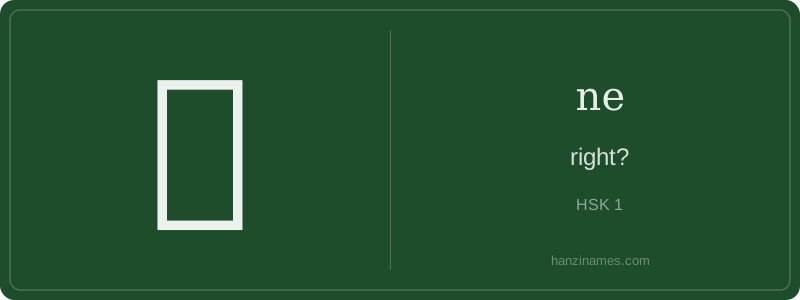
呢 is one of the most frequently used modal particles in modern Standard Mandarin, documented consistently in grammar references since the early 20th century. It appears in foundational textbooks like the 1958《汉语教科书》and remains central in HSK 1–2 curricula. Common patterns include subject + verb + 呢 (e.g., 'Nǐ máng ne?' — 'You’re busy, right?'), or standalone use to shift focus ('Tā ne?' — 'What about her?'). It rarely appears in formal writing but dominates colloquial speech, TV dramas, and social media comments.
The character 呢 is not pictographic; it evolved as a phonetic-semantic compound. Its radical 口 (mouth) signals speech-related function, while the phonetic component 尼 (ní) provides approximate pronunciation. Historically, it emerged in Middle Chinese as a grammatical particle in vernacular texts like Yuan dynasty zaju plays — not oracle bones or bronze inscriptions — and stabilized in its current form by the Ming-Qing period.
Imagine walking into a cozy Beijing teahouse on a rainy afternoon. A young barista hands you a steaming cup of jasmine tea and smiles: 'Nǐ hē chá ne?' — not a flat statement, but a gentle, inviting question: 'You’re drinking tea, right?' The character 呢 (ne) floats at the end like a soft chime — it doesn’t ask for facts, but seeks shared understanding, warmth, or gentle confirmation. It’s the linguistic equivalent of tilting your head while smiling.
This particle transforms tone instantly. Without 呢, 'Nǐ hē chá' is neutral — perhaps even abrupt. With it, the sentence breathes: curious, friendly, non-confrontational. It’s essential for sounding natural in spoken Mandarin, especially in daily exchanges among friends, family, or colleagues. Learners often overuse or underuse it — mastering 呢 means mastering the rhythm of Chinese interpersonal nuance.
Unlike question words like 吗 (ma), which demand yes/no answers, 呢 invites elaboration, reflection, or light-hearted engagement. It can also soften assertions ('Wǒ zài kàn shū ne' — 'I’m reading a book, you know') or pivot conversations ('Tā ne?' — 'What about him?'). Its power lies in its versatility and emotional lightness — a tiny character carrying the weight of relational harmony in Chinese communication.
Example Sentences
Common Compounds
Similar Characters — Don't Mix These Up
Your First Step into Chinese Culture: Get a Chinese Name
Every journey into Chinese begins with a name. Use our free Chinese name generator to create a meaningful, personalized Chinese name that fits you perfectly.
Get My Chinese Name →