哪
Character Story & Explanation
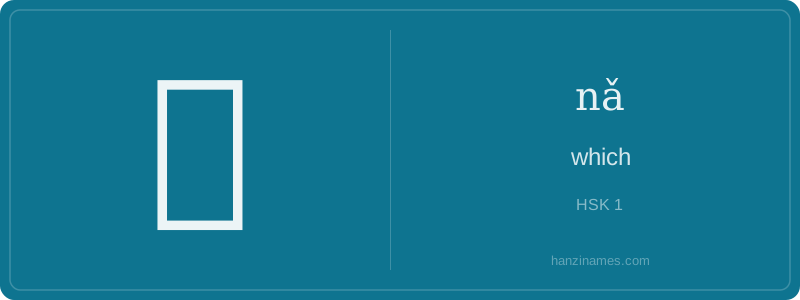
哪 is indispensable in daily Mandarin: over 95% of HSK 1–2 question sentences use it—especially in phrases like 哪里 (nǎlǐ, 'where') and 哪个 (nǎge, 'which'). Historically, it appears in Song-dynasty vernacular stories like 'The Washing Silken Gauze' (《浣纱记》), confirming its role in colloquial dialogue by the 16th century. It’s absent from classical Confucian texts, proving it’s a Late Imperial linguistic innovation rooted in spoken language—not literary tradition.
The character has no pictographic origin; it’s a phono-semantic compound created during the Tang–Song transition. Its 口 radical signals speech function, while 那 provides approximate sound. No oracle bone or bronze inscriptions contain 哪—its earliest verified forms appear in Dunhuang manuscripts (c. 9th–10th c.) as a pragmatic tool for everyday inquiry, not ritual or divination.
Our detective begins at the crime scene: the character 哪. At first glance, it appears to be a simple interrogative—yet its structure betrays deeper clues. The 口 (mouth) radical hints at speech and questioning, while the right component, 那 (nà, 'that'), acts as a phonetic hint—but not a perfect one. This mismatch signals historical sound shifts: in Middle Chinese, 那 was pronounced closer to *nɑ*, making it a plausible phonetic base for 哪’s original *nɛ* or *nɑ* reading. The character emerged late, not in oracle bones or bronzes, but in Tang–Song vernacular texts, where spoken language demanded flexible question words.
Zooming in on handwriting, the nine strokes follow a strict sequence: mouth radical first (vertical, horizontal, horizontal, vertical, horizontal), then the 那 component—dot, horizontal, vertical, hook, dot. This order reflects classical calligraphic discipline, preserving legibility across centuries of manuscript and print. Interestingly, the variant pronunciation něi arises from Beijing dialect influence, later codified in modern Mandarin standards—not as an archaic survival, but as a living phonological adaptation for rapid speech, especially before measure words like 个 (gè).
Forensic linguistics confirms 哪 never meant 'how' alone—it always functions within a frame: 哪里 (nǎlǐ, 'where'), 哪个 (nǎge, 'which one'), 哪儿 (nǎr, colloquial 'where'). Its core semantic role is *selective interrogation*: narrowing options among known possibilities. So when textbooks say 'how', they’re oversimplifying; 哪 actually asks 'in what way?' or 'by which means?' only when paired with verbs like 办 (bàn, 'to handle') or 去 (qù, 'to go'). Its power lies not in isolation, but in syntactic partnership.
Example Sentences
Common Compounds
Similar Characters — Don't Mix These Up
Your First Step into Chinese Culture: Get a Chinese Name
Every journey into Chinese begins with a name. Use our free Chinese name generator to create a meaningful, personalized Chinese name that fits you perfectly.
Get My Chinese Name →