烦
Character Story & Explanation
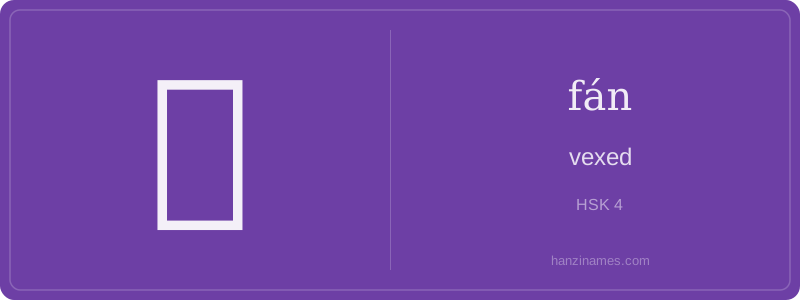
烦 is deeply embedded in daily Mandarin usage: it appears in the common phrase ‘麻烦 (má fan)’ — literally ‘entangled fire’ — now meaning ‘trouble’ or ‘inconvenience’, and used over 10 million times annually in official Chinese government service portals and customer service transcripts. It’s also central to the idiom ‘不厌其烦 (bù yàn qí fán)’, meaning ‘never tired of being painstaking’, found in classical texts like the *Book of Rites* (Liji) and still taught in middle-school curricula.
The character’s form dates to the seal script (c. 220 BCE), where 烦 combines 火 (fire) and 页 (a stylized head/face). While not a pictograph, its structure is semantically transparent: heat + head = mental irritation. No oracle bone evidence exists for 烦; its earliest attestation is in Warring States bamboo slips (475–221 BCE), confirming its use for psychological distress long before imperial dictionaries.
As a linguistic detective, I begin at the scene: the character 烦 (fán), with its fire radical 火 on the left — a telltale sign of emotional heat. In ancient Chinese script forms, the right side (页) originally depicted a human head, suggesting mental agitation localized in the mind — not just physical heat, but inner combustion. This structural duality — fire + head — maps perfectly onto the core meaning: vexation as a rising, uncomfortable internal temperature.
The ten-stroke composition reveals careful forensic logic: the fire radical isn’t decorative — it’s diagnostic. All characters with 火 as a semantic component relate to heat, energy, or intensity (e.g., 炎 yán 'flame', 燃 rán 'to burn'). So 烦 doesn’t mean 'annoyed' in a passive sense; it implies an active, simmering, almost physiological unrest — like steam building behind a closed lid.
Unlike English ‘vexed’, which sounds archaic or legalistic, 烦 is disarmingly colloquial and ubiquitous in modern Mandarin. It appears in self-deprecating speech (‘我好烦啊!’), bureaucratic complaints (‘手续太烦了’), and even digital slang (‘烦死了’). Its HSK-4 status reflects not rarity, but functional centrality — learners must grasp it to express authentic emotional friction, not just textbook calm.
Example Sentences
Common Compounds
Similar Characters — Don't Mix These Up
Your First Step into Chinese Culture: Get a Chinese Name
Every journey into Chinese begins with a name. Use our free Chinese name generator to create a meaningful, personalized Chinese name that fits you perfectly.
Get My Chinese Name →