熟
Character Story & Explanation
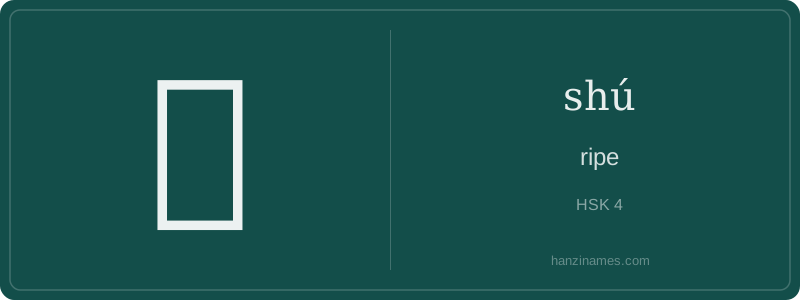
熟 is ubiquitous in modern Mandarin: used in cooking instructions (‘煮熟’—‘cook until done’), education (‘熟练’—‘proficient’), and social contexts (‘熟悉’—‘familiar with’). It appears in HSK 4 vocabulary and common idioms like ‘熟能生巧’ (shú néng shēng qiǎo, ‘practice makes perfect’)—a phrase documented in Ming-dynasty texts like Feng Menglong’s *Stories to Awaken the World* (1620), underscoring its long-standing link between repetition and mastery.
The character evolved from seal script, where the left side ‘孰’ (shú, archaic form meaning ‘who?’ or ‘which?’) served phonetic purpose, and the bottom ‘灬’ (fire radical) signaled cooking-related meaning. Though not a pictograph, its fire component reflects its earliest attested use: denoting food thoroughly cooked—verifiable in excavated Han dynasty bamboo slips listing kitchen duties.
The Chinese character 熟 (shú) conveys the core idea of 'ripeness' or 'maturity'—not just in agriculture (e.g., a ripe peach), but metaphorically across domains: knowledge (a 'well-practiced' skill), relationships ('familiar' people), and food ('cooked' or 'done'). Unlike English’s context-specific words—'ripe', 'cooked', 'familiar'—熟 unifies these meanings under one semantic umbrella, reflecting a holistic worldview where physical, cognitive, and social development share the same conceptual root.
In Western thought, maturity is often framed as a linear, age-based milestone (e.g., legal adulthood at 18), while 熟 emphasizes processual readiness: rice is shú when fully cooked, a language learner becomes shú only after repeated practice—not on a calendar date. This echoes Confucian ideals: mastery arises from sustained cultivation (xiūyǎng), not innate talent or chronological time.
Culturally, 熟 carries positive moral weight—it implies reliability and trustworthiness. A '熟人' (shúrén, 'acquaintance') is someone whose character has been tested over time, unlike a superficial '认识的人' (rènshi de rén). This parallels Western notions like 'tried-and-true' or 'seasoned', but 熟 embeds that reliability directly into the character’s etymology and daily usage—making it more than lexical; it’s an ethical marker of earned competence.
Example Sentences
Common Compounds
Similar Characters — Don't Mix These Up
Your First Step into Chinese Culture: Get a Chinese Name
Every journey into Chinese begins with a name. Use our free Chinese name generator to create a meaningful, personalized Chinese name that fits you perfectly.
Get My Chinese Name →