尔
Character Story & Explanation
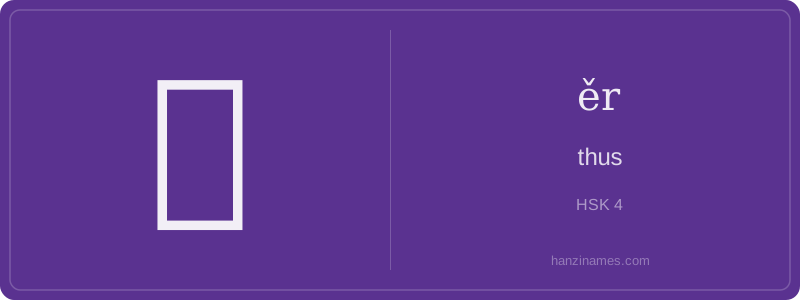
In modern Chinese, 尔 is almost exclusively literary or archaic. It appears in fixed expressions like ‘尔后’ (ěr hòu, 'thereafter'), ‘莞尔’ (wǎn ěr, 'to smile faintly'), and classical quotations such as Confucius’s '学而时习之,不亦说乎?有朋自远方来,不亦乐乎?人不知而不愠,不亦君子乎?' — where 尔 does not appear, but its grammatical kin (e.g., 尔在《论语》中 appears in variants like ‘尔所’ in later commentaries) underscores formal address. It remains vital in legal documents, academic writing, and idioms preserved in the HSK syllabus.
The character 尔 is not pictographic; its origin is phonetic-semantic. Early forms (bronze script, ~1000 BCE) show a simplified depiction of a person with emphasized head/hair, evolving into the modern shape under clerical script standardization. Today, Chinese people most commonly encounter it in printed idioms (e.g., ‘卓尔不群’ zhuó ěr bù qún — 'outstanding, peerless') or calligraphy demonstrations — not in texting or speech.
Imagine walking through Suzhou’s classical gardens on a misty autumn morning. An elderly calligrapher in a gray silk robe pauses mid-stroke, ink still glistening on rice paper. He writes 尔 — not as a standalone word, but as the elegant, archaic pronoun ‘you’ or conjunctive ‘thus’ in a couplet above a moon gate. His brush lifts deliberately: five swift strokes — two dots, a short slant, a horizontal, then a final downward flick — all rooted in the 小 (xiǎo, 'small') radical, evoking intimacy and refinement.
This character carries quiet authority. Though rarely used in spoken Mandarin today, 尔 appears in formal speeches, literary quotations, and ceremonial inscriptions — like the engraved mottoes on Qing dynasty scholar’s desks or modern university mottoes quoting Confucius. Its brevity belies its weight: in classical texts, 尔 often signals a pivot — ‘and thus’, ‘therefore’, or ‘you (who are worthy)’ — marking rhetorical gravity with minimalist grace.
For learners, 尔 is a portal into China’s linguistic stratification: it’s the whispered echo of classical Chinese surviving in HSK-4 vocabulary, not as slang or daily speech, but as cultural punctuation. Mastering it means recognizing when language shifts from conversational to ceremonial — like hearing a temple bell chime once, not for noise, but for meaning that lingers in silence.
Example Sentences
Common Compounds
Similar Characters — Don't Mix These Up
Your First Step into Chinese Culture: Get a Chinese Name
Every journey into Chinese begins with a name. Use our free Chinese name generator to create a meaningful, personalized Chinese name that fits you perfectly.
Get My Chinese Name →