申
Character Story & Explanation
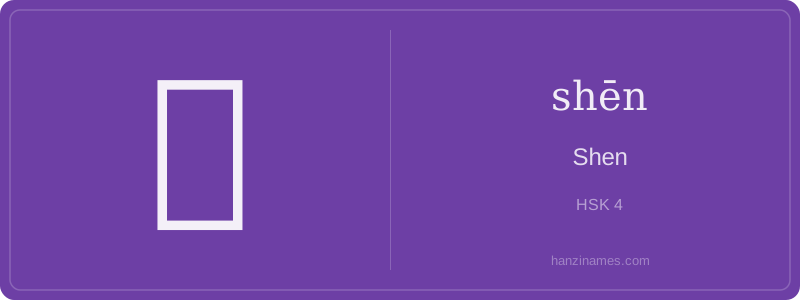
In daily life, 申 appears ubiquitously as Shanghai’s official shorthand: on license plates (沪A, 沪B… — where ‘沪’ is another ancient name, but ‘申’ appears in media and branding), in university names like 上海对外经贸大学 (Shanghai University of International Business and Economics), often nicknamed ‘申商’ (Shēn Shāng), and in local news outlets such as ‘申音’ (Shēn Yīn, a Shanghai-based cultural podcast). It’s also used in the traditional Chinese hour system — the ‘Shen hour’ (3–5 p.m.) — though this is rare in spoken modern usage.
The character 申 originated as a pictograph in oracle bone script resembling lightning (), later standardized into its current form with the 田 radical during the Qin dynasty. Scholars link it to the ancient State of Shen (申国) in present-day Henan — not directly to Shanghai, but the name was adopted by Song-era scholars who associated Shanghai’s location with the ancient ‘Shen’ fiefdom’s astrological domain. No mythical origin stories — just documented historical borrowing.
Hello, learners! The character 申 (shēn) is a foundational HSK Level 4 character with just five strokes and the 田 (tián, 'field') radical. Though it looks simple, it carries rich historical weight — most notably as the ancient abbreviation for Shanghai (上海), still seen today in official names like 申城 (Shēn Chéng, 'City of Shen'). Don’t confuse it with characters meaning 'to apply' or 'to state'; here, its usage is primarily geographical and symbolic.
Its pronunciation shēn is straightforward — a level first tone — but remember that tone consistency is crucial: saying shěn (third tone) changes the word entirely (e.g., to 'to stretch'). Practice writing it slowly: vertical stroke, then the 'field' shape (囗-like but open on top), followed by the central vertical line. This stroke order reinforces muscle memory and helps avoid common errors like misplacing the middle line.
While 申 appears in classical texts meaning 'to declare' or 'to explain', modern Mandarin mostly uses it in fixed proper nouns and formal contexts. As an HSK 4 learner, you’ll encounter it in city-related vocabulary, news headlines about Shanghai, and official documents — not in casual speech. Think of it less as a verb and more as a cultural marker: a tiny seal of Shanghai’s long identity, quietly embedded in maps, metro signs, and university names.
Example Sentences
Common Compounds
Similar Characters — Don't Mix These Up
Your First Step into Chinese Culture: Get a Chinese Name
Every journey into Chinese begins with a name. Use our free Chinese name generator to create a meaningful, personalized Chinese name that fits you perfectly.
Get My Chinese Name →