省
Character Story & Explanation
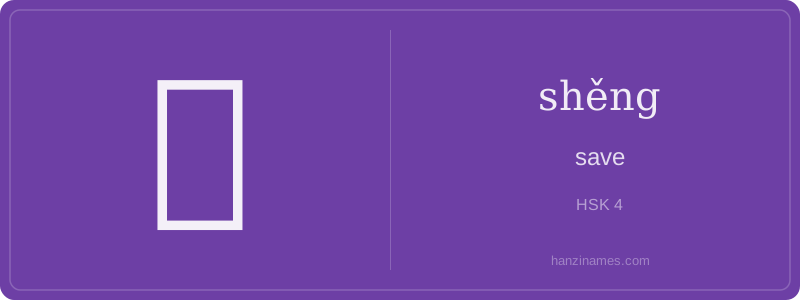
In modern Chinese life, 省 (shěng) appears ubiquitously: in government policy slogans like 节能减排 (jié néng jiǎn pái, 'energy saving and emission reduction'), in household advice ('省电'—save electricity), and in financial apps labeled '省钱技巧' (money-saving tips). The idiom 勤俭节约 (qín jiǎn jié yuē, 'diligence, frugality, thrift, and restraint') remains central to civic education, echoing state-promoted values since the 1950s. Historically, it featured in Ming-Qing era household manuals advising families to '省费养廉' (shěng fèi yǎng lián—save expenses to nurture integrity).
The character evolved from seal script (c. 3rd century BCE), where 目 (eye/radical) combined with 少 (few/less) — visually encoding 'using the eye to discern what is few or sufficient'. Though not a pictograph, this structure reflects its semantic core: mindful perception leading to measured action — seeing clearly, then acting sparingly.
The character 省 (shěng) opens a window into the Confucian-anchored Chinese value of prudent stewardship—of resources, time, energy, and even speech. To ‘save’ is not merely fiscal caution but moral discipline: conserving qi (vital energy), avoiding wastefulness in daily habits, and practicing self-restraint as a path to virtue. This reflects a worldview where scarcity is not just economic but existential—every excess risks imbalance in the harmony of self, family, and cosmos.
Its dual pronunciation reveals layered philosophy: shěng denotes material or practical economy (e.g., saving money), while xǐng carries introspective weight—‘to reflect’, ‘to examine oneself’. In classical texts like the Analects, xǐng appears in phrases like 吾日三省吾身 (‘I examine myself three times daily’), framing self-scrutiny as ethical maintenance, akin to tending a garden—not austerity for its own sake, but cultivation toward integrity.
This duality mirrors the Daoist and Neo-Confucian ideal of ‘wu wei’ (effortless action): true frugality arises not from deprivation but from discernment—knowing what to keep, what to release, and what to deepen. Thus 省 embodies both outer thrift and inner vigilance, uniting economy with ethics in a single glyph—a quiet testament to how language encodes civilization’s deepest priorities.
Example Sentences
Common Compounds
Similar Characters — Don't Mix These Up
Your First Step into Chinese Culture: Get a Chinese Name
Every journey into Chinese begins with a name. Use our free Chinese name generator to create a meaningful, personalized Chinese name that fits you perfectly.
Get My Chinese Name →