众
Character Story & Explanation
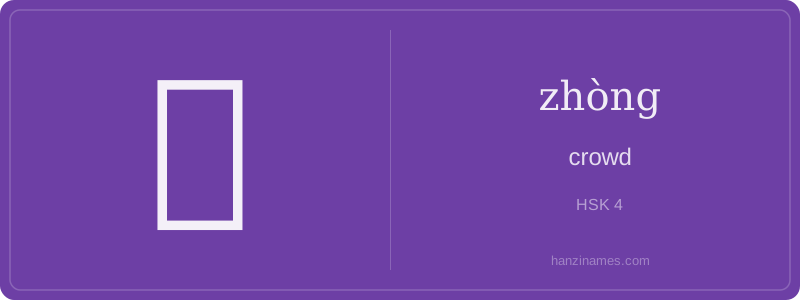
众 appears in core idioms like 众口铄金 (zhòng kǒu shuò jīn, 'many mouths melt metal')—a Han-dynasty phrase warning of the destructive power of collective opinion—and 众望所归 (zhòng wàng suǒ guī, 'where popular expectation converges'), used for widely supported leaders. It’s frequent in modern official media (e.g., 人民群众, 'the masses') and everyday terms like 众人 (zhòng rén, 'everyone'). Historically, it appears in excavated bamboo slips from the Warring States period (475–221 BCE), confirming its early use for 'multitude'.
The character is a clear semantic compound: three 人 (rén, 'person') radicals stacked vertically—a documented 'triplication for plurality' pattern seen in early seal script (c. 3rd century BCE). No oracle-bone form survives, but the Qin dynasty small seal script already shows the triple-person structure, explicitly denoting 'many people' without pictorial abstraction.
The character 众 (zhòng) embodies a foundational principle in Chinese worldview: collective strength over individual prominence. Its structure—three 'people' (人) stacked vertically—visually affirms that human flourishing arises not in isolation, but through interdependence and shared purpose. This reflects Confucian ideals of social harmony and the Daoist understanding of multiplicity as natural order—not chaos, but generative abundance.
In classical texts like the Book of Documents and Mencius, 众 consistently denotes the people as a moral and political subject—the source of legitimacy for rulers ('the people are the foundation of the state'). Unlike Western individualism, Chinese thought often treats 'the crowd' not as an anonymous mass, but as a living, ethical body whose welfare defines righteous governance.
This worldview persists today: public discourse frequently invokes 众 to signal consensus, civic responsibility, or grassroots agency—e.g., in phrases like 众志成城 ('the will of the people builds an unbreakable city wall'). Even digital culture echoes this: WeChat groups are called 群 (qún), but their active, participatory nature resonates with the spirit of 众—relational, dynamic, and inherently communal.
Example Sentences
Common Compounds
Similar Characters — Don't Mix These Up
Your First Step into Chinese Culture: Get a Chinese Name
Every journey into Chinese begins with a name. Use our free Chinese name generator to create a meaningful, personalized Chinese name that fits you perfectly.
Get My Chinese Name →