研
Character Story & Explanation
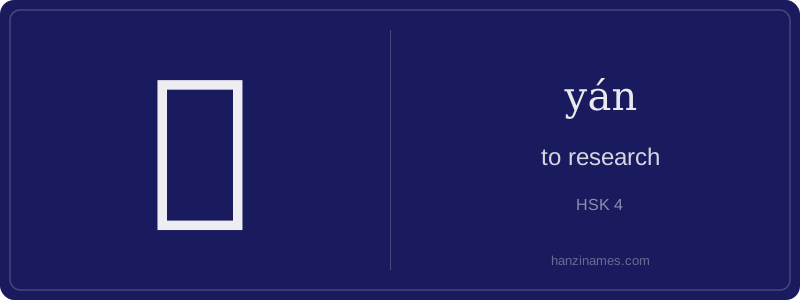
研 is ubiquitous in modern Chinese academic and professional life: universities use it in titles like 研究生 (yánjiūshēng, 'graduate student') and government agencies in terms like 科学研究院 (kēxué yánjiūyuàn, 'Academy of Sciences'). The idiom 精研细磨 (jīng yán xì mó)—literally 'refine through meticulous research and grinding'—appears in educational policy documents to emphasize rigorous scholarship.
The character first appeared in seal script (c. 3rd century BCE), where it combined 石 (stone) and 开 (to open/activate). Scholars agree this reflected the act of grinding inkstones to prepare for writing—essential for scholars before inksticks were pre-mixed. No oracle-bone form survives, but bronze inscriptions confirm its early association with scholarly preparation, not literal milling.
Hello students! Today we’re learning 研 (yán), a Level 4 HSK character with 9 strokes and the ‘stone’ radical (石). Though its original meaning was 'to grind'—like grinding inkstones or herbs—the modern usage has evolved into abstract intellectual activity: 'to study', 'to research', or 'to analyze'. Don’t be surprised that a stone-related character now means academic work—it reflects how ancient tools shaped language: grinding ink required patience and precision, just like deep thinking!
This character appears in many formal, scholarly contexts—not in casual chat. You’ll see it on university department signs (e.g., 研究生院 yánjiūshēngyuàn, Graduate School) and official documents. Its tone is serious and respectful, so it’s rarely used alone; instead, it pairs with other characters to form compound words like 研究 (yánjiū, 'research') or 研发 (yánfā, 'R&D').
Remember: 研 is not about physical grinding today—but the idea remains: careful, repeated effort to refine understanding. Think of it as 'grinding knowledge into wisdom'. As you practice writing it, notice how the left side (石) grounds the character literally and figuratively, while the right side (开) suggests opening up or unlocking ideas through disciplined work.
Example Sentences
Common Compounds
Similar Characters — Don't Mix These Up
Your First Step into Chinese Culture: Get a Chinese Name
Every journey into Chinese begins with a name. Use our free Chinese name generator to create a meaningful, personalized Chinese name that fits you perfectly.
Get My Chinese Name →