确
Character Story & Explanation
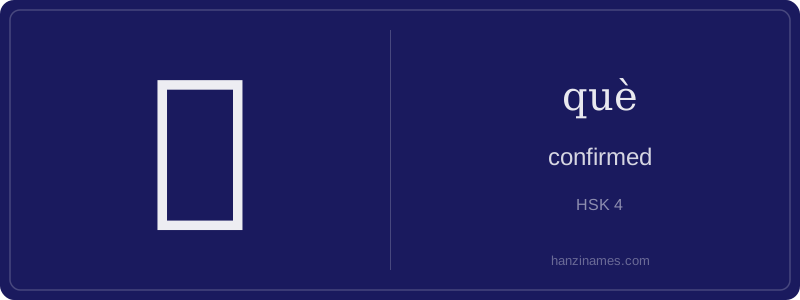
In everyday China, 确 appears constantly in high-trust contexts: QR code payment confirmations ('请确认付款' — 'Please confirm payment'), government service portals ('信息已确权' — 'Information rights have been authenticated'), and news headlines verifying facts ('经多方核实,消息确系属实' — 'After verification by multiple sources, the report is confirmed true'). It’s central to the phrase 确凿 (quèzáo, 'irrefutable evidence'), used in legal and journalistic settings since at least the Ming dynasty.
The character evolved from seal script around the Qin dynasty. Its left side 石 is the 'stone' radical — historically associated with durability and permanence — while the right side 隹 was repurposed as a phonetic element (què) from earlier forms meaning 'short-tailed bird'. No pictographic origin exists; it's a phono-semantic compound standardized in the Shuōwén Jiězì (100 CE), where it was defined as 'true, real, verified'.
The character 确 (què) conveys certainty, authenticity, and verification — not just 'yes', but 'confirmed beyond doubt'. Its radical 石 (stone) hints at solidity and reliability, while the right component 隹 (originally a short-tailed bird, now phonetic) contributes the sound 'què'. In modern usage, 确 is rarely standalone; it appears in compound words where precision matters — like official documents, scientific claims, or digital security.
At HSK Level 4, learners encounter 确 primarily in verbs like 确认 (quèrèn, 'to confirm') and adverbs like 确实 (quèshí, 'indeed'). Unlike casual affirmatives like 是 (shì) or 对 (duì), 确 carries weight — it implies cross-checking, evidence, or institutional validation. This nuance reflects China’s emphasis on verifiable truth in education, law, and public communication.
Its 12-stroke structure follows a left-right pattern: stone radical on the left grounds the meaning in tangibility; the right side provides pronunciation and subtle semantic reinforcement (historically linked to 'truth' via ancient phonetic loans). Learners benefit from practicing stroke order with attention to the final horizontal stroke of 隹 — a small but critical detail that distinguishes it from similar characters like 准 (zhǔn, 'accurate').
Example Sentences
Common Compounds
Similar Characters — Don't Mix These Up
Your First Step into Chinese Culture: Get a Chinese Name
Every journey into Chinese begins with a name. Use our free Chinese name generator to create a meaningful, personalized Chinese name that fits you perfectly.
Get My Chinese Name →