识
Character Story & Explanation
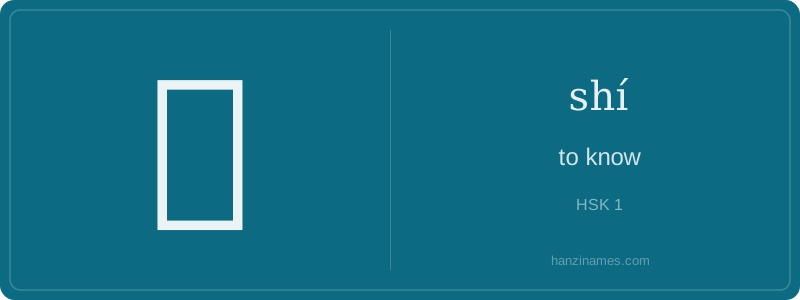
识 is central to China’s century-long literacy campaigns: since the 1950s, '识字运动' (literacy movements) taught tens of millions to read, framing 'knowing characters' as civic duty and social advancement. Common phrases like 识别 (shíbié, 'to identify') appear daily in health QR code scanning, bank security, and AI-powered facial recognition—where 'recognition' blends technology and trust. The idiom 见多识广 (jiàn duō shí guǎng, 'broadly experienced and widely knowledgeable') remains a high compliment, valuing lived wisdom over mere information.
The character evolved from seal script (c. 3rd c. BCE), where 识 combined 讠 (speech radical) and 戌 (xū, an ancient weapon symbolizing vigilance/discernment). By Han dynasty texts, it consistently meant 'to recognize/know through attentive engagement'—not innate understanding, but knowledge earned through observation and reflection.
The character 识 (shí) opens a window into the Confucian-rooted Chinese worldview where 'knowing' is never passive recognition—it is active, relational, and morally grounded. To 识 something is to acknowledge its place in a web of meaning: a person, a principle, or a truth that demands response. This reflects the classical ideal of 'knowledge as virtue'—to truly know is to align one’s conduct with what is known.
In traditional Chinese epistemology, cognition begins not with abstraction but with naming and discernment. The radical 讠 (speech/saying) paired with 识 signals that knowledge is inherently communicable and socially validated. You do not 'know in isolation'; you recognize, name, and share—making 识 both cognitive and communal. This echoes the Analects’ emphasis on 'knowing others' (知人) as foundational to ethical leadership.
Even today, 识 carries this layered resonance: from literacy (识字) to moral discernment (识别是非), it implies judgment shaped by experience and tradition. Unlike Western binaries of 'knowing vs. believing', 识 bridges perception, memory, and responsibility—suggesting that true knowledge is always embodied, contextual, and ethically consequential.
Example Sentences
Common Compounds
Similar Characters — Don't Mix These Up
Your First Step into Chinese Culture: Get a Chinese Name
Every journey into Chinese begins with a name. Use our free Chinese name generator to create a meaningful, personalized Chinese name that fits you perfectly.
Get My Chinese Name →