晚
Character Story & Explanation
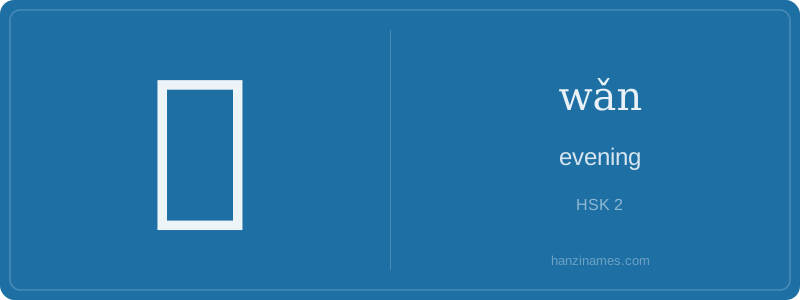
晚 has been used for over two millennia to denote the latter part of the day. In classical texts like the Book of Songs (Shījīng, c. 11th–7th c. BCE), 晚 appears in poetic lines describing dusk and seasonal transitions. Today, it’s indispensable in daily life: from train schedules ('G102 departs at 8:30 p.m.' → 晚上八点半发车) to news headlines ('evening edition' → 晚报) and popular phrases like 晚安 (wǎn’ān, 'good night'). It’s also central to idioms such as 为时已晚 (wéi shí yǐ wǎn, 'it’s already too late').
The character is a semantic-phonetic compound: the left radical 日 (sun/day) signals its time-related meaning; the right component 免 (miǎn) originally suggested pronunciation (though modern sound has shifted slightly). Archaeological evidence confirms this structure appeared in standardized small seal script (c. 221 BCE) and remains unchanged in modern writing.
Hello, learners! The character 晚 (wǎn) means 'evening' — the peaceful time after sunset but before bedtime. It’s an HSK Level 2 character, so it appears early in your studies and is essential for telling time, greeting people, and describing daily routines. Notice its radical 日 (rì), meaning 'sun' or 'day' — this tells us the character relates to time of day. The right side 免 (miǎn) isn’t a standalone meaning here but helps with pronunciation and distinguishes it from other 'sun'-related characters.
When you see 晚, think of twilight: warm light fading, families gathering for dinner, or students finishing homework. It’s not just a clock-based concept — in Chinese, 晚 carries gentle, reflective connotations. You’ll often meet it in greetings like 晚上好 (wǎnshàng hǎo, 'Good evening') and time expressions like 晚上七点 (wǎnshàng qī diǎn, '7 p.m.'). Unlike English, where 'evening' can stretch from 5 p.m. onward, Chinese usage typically starts around 6–7 p.m., especially in formal or polite contexts.
This character is also used in common compound words and even as a polite softener — for example, saying 我晚到了 (Wǒ wǎn dào le, 'I arrived late') sounds more courteous than just using 迟 (chí). Its stroke count is 11, and it follows a logical structure: left (sun/day) + right (phonetic component). Practicing it regularly will help you recognize many related time words — like 早 (zǎo, 'early') and 明 (míng, 'bright/morning') — building your visual literacy in Chinese script.
Example Sentences
Common Compounds
Similar Characters — Don't Mix These Up
Your First Step into Chinese Culture: Get a Chinese Name
Every journey into Chinese begins with a name. Use our free Chinese name generator to create a meaningful, personalized Chinese name that fits you perfectly.
Get My Chinese Name →