晴
Character Story & Explanation
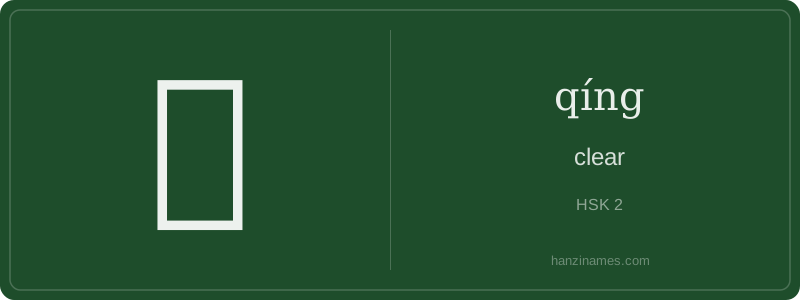
晴 is ubiquitous in modern Chinese daily life—especially in weather forecasts, apps, and public announcements. It appears in the national weather service’s standard terminology (e.g., 晴, 多云, 阴) and is central to the widely used phrase 晴天霹雳 (qíngtiān pīlì, 'a bolt from the blue'), a documented idiom since at least the Ming dynasty (14th–17th c.) meaning a shocking, unexpected event. It also features in classical poetry, such as Du Fu’s Tang-dynasty lines describing mountain vistas after rain clears.
The character is a phono-semantic compound: 日 (sun) as semantic radical, and 青 (qīng, 'blue/green') as phonetic component—first attested in seal script (c. 3rd century BCE). Its form has remained stable for over 2,000 years, consistently representing visible, unobstructed sunlight—a direct pictographic evolution from early depictions of sun above a horizon line.
晴 (qíng) is a foundational HSK Level 2 character meaning 'clear'—most commonly referring to clear weather, especially a cloudless, sunny sky. Its radical 日 (rì, 'sun') anchors its semantic field in daylight and visibility, while the phonetic component 青 (qīng, 'blue/green') hints at both pronunciation and visual association: a clear blue sky. Unlike English ‘clear’, which spans abstract domains (e.g., ‘clear instructions’), 晴 is almost exclusively meteorological or poetic—used for weather reports, poetry, and idioms tied to brightness and openness.
In Chinese linguistic culture, 晴 carries positive emotional resonance—symbolizing hope, clarity of mind, and auspiciousness. This contrasts with Western associations where ‘clear’ is neutral or functional (e.g., ‘clear file permissions’). In classical poetry, 晴 often appears alongside 雨 (yǔ, rain) to mark emotional or seasonal transitions—reflecting Daoist balance rather than binary opposition. Its positivity is culturally reinforced: ‘sunny day’ (晴天) is proverbially linked to good fortune and mental well-being.
Western equivalents like ‘sunny’ or ‘fair’ are narrower in scope and lack the character’s lexical versatility. While English uses separate words for weather (‘sunny’), cognition (‘clear-headed’), and transparency (‘clear glass’), 晴 remains tightly bound to luminosity and atmospheric clarity—never used for abstract clarity or transparency. This semantic restraint reflects Chinese writing’s logographic precision: one character, one core sensory domain. Learners benefit from pairing it with verbs like 有 (yǒu, ‘to have’) or 是 (shì, ‘to be’) to form natural phrases like 今天是晴天 (Today is a clear day).
Example Sentences
Common Compounds
Similar Characters — Don't Mix These Up
Your First Step into Chinese Culture: Get a Chinese Name
Every journey into Chinese begins with a name. Use our free Chinese name generator to create a meaningful, personalized Chinese name that fits you perfectly.
Get My Chinese Name →