最
Character Story & Explanation
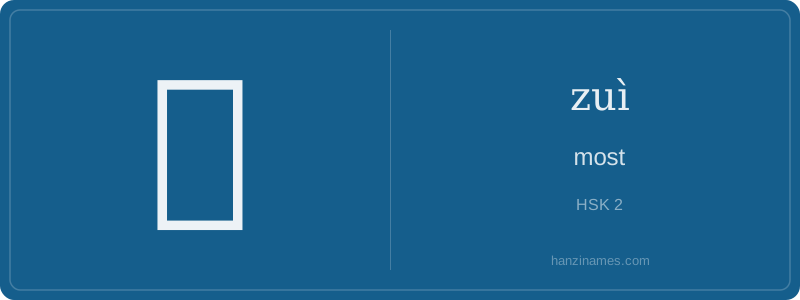
最 is ubiquitous in contemporary Chinese: it appears in advertising ('最畅销' — best-selling), education ('最高分' — highest score), and digital life ('最新消息' — latest news). A well-documented phrase is 最早 (zuì zǎo, 'earliest'), used since at least the Han dynasty in historical texts like the Shuōwén Jiězì (121 CE) to denote temporal extremes. It's also central in idioms like 最后通牒 (zuì hòu tōng dié, 'ultimatum'), borrowed from Western diplomatic usage in the late Qing era.
The character’s earliest verified form appears in clerical script (Lìshū) during the Han dynasty. While not a pictograph, its structure combines 曰 (a variant of 日 rì, 'sun', later stylized as 'say') and 取 (qǔ, 'to take'). Scholars agree it evolved phonetically and semantically to mean 'utmost' — not from visual imagery, but through usage. Today, Chinese learners first encounter 最 in classroom phrases like '你最喜欢什么?' — a real-life question asked millions of times daily.
Hi students! The character 最 (zuì) is one of the most frequently used adverbs in Chinese — it means 'to the highest degree' or 'most', just like '-est' in English (e.g., tallest, fastest). It always comes before an adjective or verb to show superlative meaning. Unlike English, Chinese doesn’t change word forms for comparison — instead, we use 最 to express extremes. Think of it as a spotlight: it shines on whatever follows and says, 'This is the top one!' You’ll see it everywhere — from menus ('最便宜' = cheapest) to exams ('最简单' = easiest).
Most importantly, 最 cannot stand alone — it must modify another word. You’d never say '这是最' (This is most); you must say '这是最好的' (This is the best). Also, remember that 最 is *not* used for comparisons between just two things — for that, we use 更 (gèng, 'more'). So 最 is reserved for three-or-more items or absolute superlatives. Mastering this distinction early will help you sound natural and avoid common mistakes.
At HSK Level 2, 最 appears constantly — in listening, reading, and speaking tasks. Its 12 strokes follow a clear structure: top radical 曰 (yuē, 'to speak'), then the bottom part 取 (qǔ, 'to take') — historically hinting at 'taking the utmost'. Though the modern form no longer visually suggests 'highest', its function is crystal clear: it’s your go-to tool for expressing peaks — of quality, quantity, emotion, or effort. Practice writing it slowly, stroke by stroke, and use it daily in simple sentences like '我最喜欢...' (I like... the most).
Example Sentences
Common Compounds
Similar Characters — Don't Mix These Up
Your First Step into Chinese Culture: Get a Chinese Name
Every journey into Chinese begins with a name. Use our free Chinese name generator to create a meaningful, personalized Chinese name that fits you perfectly.
Get My Chinese Name →