足
Character Story & Explanation
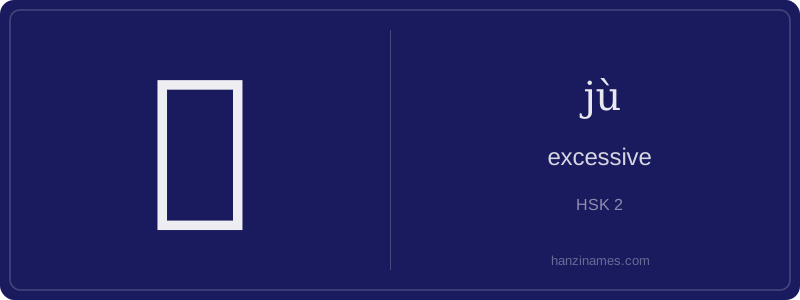
In modern Standard Mandarin, 足 pronounced jù appears almost exclusively in classical compounds and idiomatic expressions — most notably in the four-character idiom 足智多谋 (jùzhì duōmóu), meaning 'excessively intelligent and resourceful', used historically to describe brilliant but potentially untrustworthy strategists like Zhuge Liang (though ironically, he was praised for balance — the phrase now often carries subtle irony or warning). It also occurs in classical texts such as the Zuo Zhuan and Guoyu, where jù modifies virtues or traits to signal dangerous overdevelopment.
The character 足 itself is a pictograph-origin radical: bronze inscriptions (c. 12th–3rd c. BCE) clearly depict a stylized human foot with toes and arch. Its original meaning was purely anatomical ('foot'), later extending to 'sufficient' (as in 'enough to stand on one’s own'). The 'excessive' sense (jù) emerged secondarily in classical syntax as an intensifier — not from the foot image, but from grammatical extension of zú's 'sufficiency' meaning into 'more-than-sufficient'.
The character 足 (jù) meaning 'excessive' is a fascinating lexical outlier — though its primary reading zú means 'foot' or 'sufficient', the rare literary pronunciation jù carries the nuanced sense of 'overabundant', 'to excess', or 'unduly'. This duality reflects a core Chinese philosophical sensibility: meaning is deeply contextual, and even a single graph can pivot between concrete embodiment (the foot as foundation) and abstract evaluation (excess as imbalance). In classical texts, jù signals moral or aesthetic overstepping — not mere quantity, but violation of harmony.
This usage embodies the Confucian and Daoist ideal of zhōngyōng (the Mean): virtue lies in measured appropriateness, not extremes. To say something is 足 (jù) is thus quietly critical — it implies deviation from natural or social equilibrium. Unlike English ‘excessive’, which often focuses on scale, jù conveys ethical weight: excess isn’t just big, it’s *inappropriate*. The character thus functions as a cultural thermometer, registering when abundance crosses into wastefulness, zeal into fanaticism, or rigor into rigidity.
Modern Mandarin rarely uses jù in speech; it survives almost exclusively in fixed literary expressions and classical allusions. Yet its persistence reveals how Chinese semantic architecture preserves ethical precision across millennia. Even today, when a teacher warns a student against 足智 (jùzhì — 'excessive cleverness'), they invoke an ancient caution: intelligence untempered by humility or purpose becomes self-defeating. Thus, 足 (jù) is less a word than a philosophical punctuation mark — a brief, sharp reminder that in Chinese thought, the right amount is never merely arithmetic, but relational, contextual, and deeply human.
Example Sentences
Common Compounds
Similar Characters — Don't Mix These Up
Your First Step into Chinese Culture: Get a Chinese Name
Every journey into Chinese begins with a name. Use our free Chinese name generator to create a meaningful, personalized Chinese name that fits you perfectly.
Get My Chinese Name →