声
Character Story & Explanation
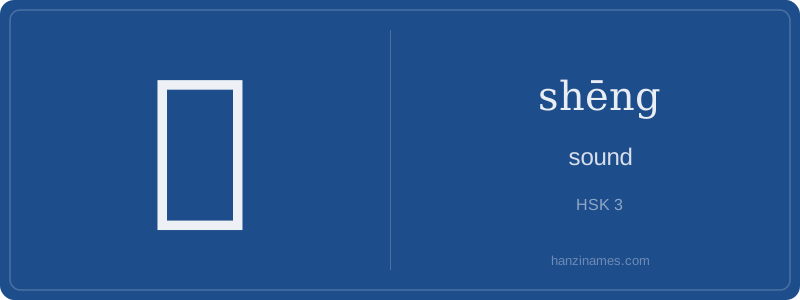
声 is ubiquitous in daily Chinese: it appears in HSK 3 vocabulary like 声音 (shēngyīn, 'voice/sound'), 广播声 (guǎngbō shēng, 'broadcast audio'), and the idiom 有口皆碑 (yǒu kǒu jiē bēi, 'praised by all mouths')—where 声 implies collective vocal affirmation. Historically, it featured in Tang-dynasty poetry to evoke auditory imagery (e.g., Wang Wei’s 'empty mountain—no one in sight, yet human voices echo'), reflecting its role in evoking presence through absence.
The character’s seal-script form (c. 200 BCE) clearly shows ⼝ (mouth) atop a phonetic component derived from 真 (zhēn), later simplified to 士. While the radical is officially 士, this is a structural artifact—not semantic. In practice, Chinese learners today encounter 声 most often in listening exercises, voice-recognition apps, and music notation (e.g., 声部 'vocal part').
Our detective work begins with the oracle-bone and bronze inscriptions—though 声 doesn’t appear in earliest forms as a standalone character, its later seal-script version (c. 3rd century BCE) reveals a clever phonosemantic design: the top component ⾊ (later simplified to ⼝, 'mouth') suggests vocal origin, while the bottom 士 ('scholar' or 'gentleman') originally served as a phonetic hint (shēng was once closer in sound to shì). This reflects how ancient scribes prioritized both meaning and pronunciation in character creation.
By the Han dynasty, 声 stabilized into its modern shape—still retaining ⼝ at the top, now paired with a stylized form of 真 (zhēn, 'true') in clerical script, which eventually condensed into today’s 士 radical. Despite the radical being classified as ‘scholar’, it functions here purely as a structural placeholder; the true semantic core is the mouth ⼝, emphasizing voiced, audible emission—not abstract thought, but physical sound production.
Interestingly, 声 rarely stands alone in classical texts; it appears most often in compound words like 音聲 (yīnshēng, 'sound/tone') or 聲譽 (shēngyù, 'reputation'), where its meaning extends metaphorically from acoustic vibration to social resonance. This semantic expansion—from physics to ethics—mirrors how Chinese philosophy treats sound as inseparable from human presence and moral weight, as seen in Confucian emphasis on proper tone (shēng) in ritual speech.
Example Sentences
Common Compounds
Similar Characters — Don't Mix These Up
Your First Step into Chinese Culture: Get a Chinese Name
Every journey into Chinese begins with a name. Use our free Chinese name generator to create a meaningful, personalized Chinese name that fits you perfectly.
Get My Chinese Name →