旧
Character Story & Explanation
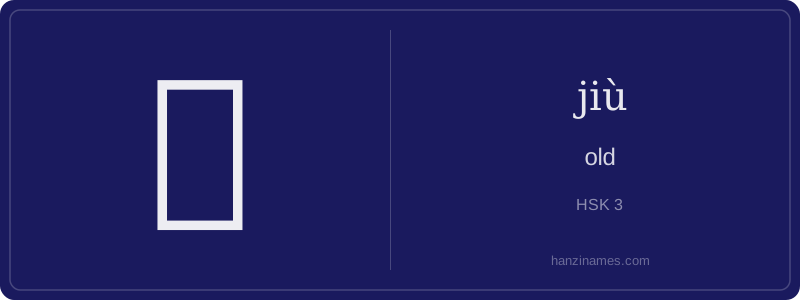
In daily life, 旧 is ubiquitous: from 旧书 (jiù shū, secondhand books) sold in Beijing’s Panjiayuan market since the 1980s, to official terms like 旧城改造 (jiù chéng gǎizào, 'old city renovation') in urban planning policy since the 2000s. It appears in the idiom 新旧交替 (xīn jiù jiāotì, 'transition between old and new'), widely used in news reports about leadership changes or technological shifts. Historically, 旧 was standard in imperial edicts referencing prior reigns (e.g., 旧制, 'former regulations').
The character’s earliest attested form appears in seal script (c. 3rd century BCE), where 日 (sun/day) combines with a simplified depiction of a bird’s wing (now lost in clerical script evolution)—symbolizing repeated cycles (like birds returning seasonally). Though the wing element vanished, the sun radical preserves its temporal core. Modern usage reflects this: 旧 always implies time-relative status, never absolute antiquity.
As an archaeologist brushing dust from a Han dynasty bamboo slip, I find 旧 inscribed beside tax records—its five strokes not merely 'old' but layered with temporal weight. The radical 日 (sun/day) anchors it in time’s passage; the left component 丨丿一 (a simplified form of 舊’s ancient structure) evokes worn surfaces, repeated use, elapsed cycles. This isn’t abstract age—it’s the patina on bronze mirrors, the fading ink of ancestral letters.
Excavating further into Tang manuscripts, 旧 appears in poetry as both lament and reverence: Du Fu writes of ‘old friends’ (旧友) whose bonds outlast dynasties. Here, 旧 carries emotional gravity—not decay, but continuity. Its minimal stroke count (5) belies deep semantic resonance: it marks what endures *despite* time, not just what predates the present.
In Ming legal documents, 旧 is used to distinguish prior statutes (旧法) from newly promulgated ones—revealing its role in institutional memory. Unlike generic terms for age, 旧 implies *relational temporality*: something old *in contrast to what is new*. This nuance survives today: we say 旧手机 (old phone) not because it’s ancient, but because it’s been replaced. The character is a cultural timestamp—quiet, precise, deeply functional.
Example Sentences
Common Compounds
Similar Characters — Don't Mix These Up
Your First Step into Chinese Culture: Get a Chinese Name
Every journey into Chinese begins with a name. Use our free Chinese name generator to create a meaningful, personalized Chinese name that fits you perfectly.
Get My Chinese Name →